
Pakistan has significantly increased the price of high-octane fuel, impacting luxury vehicle owners, while also seeing increases in petrol, diesel, and airline fares due to rising global oil prices.

Indian benchmark stock indices, Sensex and Nifty, recorded their fourth consecutive day of declines, driven by selling in FMCG, financial, and auto sectors. The downturn is attributed to fresh tensions in the Middle East, uncertainty surrounding the US-Iran 60-day ceasefire, and elevated crude oil prices.

The Israeli Finance Ministry has warned that the ongoing war with Iran could cost Israel an estimated NIS 9.4 billion (USD 3 billion approximately) per week under current restrictions on economic activities.

Iran launched retaliatory military strikes targeting Israel and American military bases across the region, including in Qatar, the United Arab Emirates, Kuwait, Bahrain and Jordan.

US Secretary of State Marco Rubio stated that significant progress has been made in negotiations with Iran to reopen the Strait of Hormuz, a critical global shipping lane. However, President Donald Trump remains cautious, vowing not to accept a 'bad deal' regarding Iran's nuclear programme and regional stability.

Two youths from Rajasthan were killed in drone attacks in Oman amid the ongoing conflict involving the United States, Israel and Iran.

An Indian national was killed and several others injured in a drone attack on Kuwait International Airport, leading to the suspension of air traffic and significant damage. This incident marks the tenth Indian fatality since hostilities between the US and Iran began in February, with other Indians also affected by regional conflicts in UAE, Saudi Arabia, and Oman.

US President Donald Trump said on Thursday the Iranian men's national soccer team was welcome to participate in the 2026 World Cup but that he believed it was not appropriate that they be there "for their own life and safety."

Prime Minister Narendra Modi and Indonesian President Prabowo Subianto have significantly advanced the India-Indonesia Comprehensive Strategic Partnership, securing crucial agreements on defence, critical minerals, and maritime security, including BrahMos missile supply and Sabang port development.

Tensions escalate at the UN Security Council as the US and Israel defend their military actions against Iran, while Iran condemns the strikes as war crimes, raising fears of a wider Middle East conflict.

Iran is observing 40 days of public mourning following the death of Ayatollah Ali Khamenei, Reuters reported, citing Iranian state media.

Rudi Garcia's comments about Senegal's tactical structure, along with other pundit remarks, have reignited scrutiny over racially coded language in World Cup commentary, drawing criticism from scholars and anti-racism advocates who argue such language perpetuates harmful stereotypes about Black players and African teams.
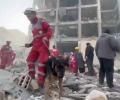
Despite the escalation in US military action, the War Secretary noted that Iran's missile response has declined in the last 24 hours.

Passenger vehicle sales in India are estimated to have surged by nearly 25 per cent in June 2024, reaching approximately 4 lakh units, with Maruti Suzuki, Tata Motors PV, and Mahindra & Mahindra leading the growth, despite concerns over geopolitical tensions and monsoon impact.

The IRGC also warned residents to evacuate areas near military bases, security centres and government facilities.

US President Donald Trump and Russian President Vladimir Putin discussed the Iran conflict and its impact on global energy supplies during a phone call.

Australia secured their spot in the World Cup's round of 32 after a 0-0 draw against Paraguay. The Socceroos finished second in Group D and will face the second-placed team from Group G. Paraguay now faces an anxious wait to see if they qualify as one of the best third-placed teams.

Trump's phone calls with Netanyahu came after Iran threatened to end the negotiations with the US over Israel's attacks on Lebanon. Netanyahu had said Israel would hit "terror targets" in Beirut if Hezbollah did not stop attacking Israel.

Non-banking financial companies (NBFCs) reported encouraging results for Q4FY26 with improved asset quality and earnings, but analysts maintain a cautious near-term outlook due to geopolitical tensions, monsoon risks, and specific portfolio concerns.

Indian markets on Dalal Street rallied sharply as easing tensions in the US-Iran conflict and stable oil prices boosted sentiment. Track Nifty 50 and BSE Sensex performance and key global triggers.

Indian stock market benchmark indices Sensex and Nifty rebounded in early trade, driven by a decline in crude oil prices, supportive global cues, fresh foreign fund inflows, and buying in blue-chips like Reliance Industries and HDFC Bank. Track Sensex, Nifty movement on June 22, 2026.
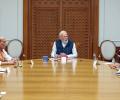
Prime Minister Narendra Modi will chair a meeting of the Cabinet Committee of Security (CCS) in Delhi to discuss the global situation following the attack on Iran and the killing of Iranian Supreme Leader Ayatollah Ali Khamenei.
Suspected insurgents have abducted four policemen and their official vehicle in Gwadar, Balochistan, a sensitive region vital to the China-Pakistan Economic Corridor. A search operation is underway, with initial investigations suggesting the police were involved in illegal detentions. The incident occurs amidst ongoing anti-terror operations and recent attacks in the province.

The White House on Sunday is witnessing a "fight night" in an octagon-shaped cage as the Ultimate Fighting Championship (UFC) fighters slug it out in the marquee event on the South Lawn on a day President Donald Trump turned 80.

External Affairs Minister S Jaishankar addressed the Rajya Sabha on India's position regarding the escalating conflict in West Asia, emphasising the need for peace, dialogue, and the safety of civilians, while also prioritising India's energy security and trade interests.

The rupee has been among the The RBI uses the Iran-US peace deal to bolster its forex reserves.


Kerala Chief Minister Pinarayi Vijayan has expressed concern over the situation in the Gulf region following the US-Israel attack on Iran and has urged the central government to take necessary steps to ensure the safety of Indian nationals residing there.

US forces have launched search and rescue efforts for a US fighter jet, which several news outlets, including the Wall Street Journal and CNN, said had been shot down over Iran.
Indian markets on Dalal Street rallied sharply as easing tensions in the US-Iran conflict and stable oil prices boosted sentiment. Track Nifty 50 and BSE Sensex performance and key global triggers.

Iranian President Masoud Pezeshkian stated that Iran is considering various paths to address regional tensions, including negotiations conducted with dignity and authority, while emphasising that military gains should be reinforced through diplomacy.

Russian President Vladimir Putin is set to visit China for talks with Chinese leader Xi Jinping, shortly after US President Donald Trump's visit to Beijing. The visit underscores the close strategic ties between China and Russia amid global tensions.

As many as 35 vessels, including cargo carriers and oil tankers, successfully navigated through the strategic maritime chokepoint of the Strait of Hormuz over the last 24 hours, according to Iran's state media reports citing a formal declaration by the Islamic Revolutionary Guard Corps (IRGC) Navy.

American Grandmaster Hikaru Nakamura has criticised the International Chess Federation (FIDE) for its stringent anti-cheating measures at the Candidates Tournament in Cyprus.

Mostafa "Zico" Mohamed, initially planning a summer vacation, received an unexpected call-up to the Egyptian national team for the World Cup. He has since become a standout performer, scoring and assisting in Egypt's historic 3-1 victory over New Zealand, their first-ever World Cup win, and is now crucial to their knockout stage aspirations.

S&P Global Ratings projects India's economic growth to slow to 6.6 per cent in FY27, down from 7.7 per cent in FY26, citing energy stress and a potential sub-par monsoon.

Indian benchmark equity indices, the BSE Sensex and NSE Nifty, experienced a significant drop in early trade due to elevated oil prices, weak global market trends, and renewed fears of military operations in the Middle East following US President Donald Trump's statements regarding Iran. Track Sensex, Nifty on May 20.

'Much later when I came to Afghanistan, I realised that there were songs in Bollywood films.'

With Gulf countries emerging as popular destinations for Indian weddings and pre-wedding shoots, the March-April season had seen a flurry of bookings.

British Prime Minister Keir Starmer has called for a negotiated settlement with Iran and deployed additional fighter jets to West Asia to strengthen the UK's defensive operations.
